

Jump to the 30-second cheat sheet for the key points.
One little fix at a time, we’ll make your house a home! Damp basement? Let’s figure out which “French drain” people actually mean, because there are two very different systems hiding under that one phrase.
- Interior drains (often called interior footing drains or an interior perimeter drain) collect water at the wall base and slab edge after it has made it to the basement, then route it to a sump pump.
- Exterior French drains (an exterior trench drain installed near the footing) intercept groundwater before it builds pressure against the foundation wall, then discharge it away from the house or to a sump where needed.
Both can help. The “best” one depends on where the water is coming from, how much disruption you can handle, and whether you are trying to manage water or reduce the chances of it entering at all.
Start here first
Before you spend real money on drains, do a quick triage. These basics solve more “basement seepage” than you would think.
- Gutters and downspouts: make sure gutters are not overflowing and extend downspouts well away from the foundation.
- Grading: the soil should slope away from the house so surface water does not pond at the foundation.
- Window wells: clear debris, confirm the well drains, and check that water is not spilling over the rim during storms.
- Rule out non foundation sources: condensation, a leaking hose bib, and plumbing leaks can mimic groundwater issues.
For more basement moisture basics and common fixes, you can also browse Basements & Moisture and our guide to DIY basement waterproofing for damp concrete walls.
Fast answer: which keeps water out?
If the goal is reducing the risk of water coming through the wall in the first place, an exterior French drain plus exterior waterproofing is usually the most direct approach because it reduces hydrostatic pressure against the foundation and helps the wall stay drier.
It is not a guarantee in every home. High water tables, poor discharge planning, foundation cracks, window wells, or water entering higher up the wall can still cause trouble.
If the goal is stopping wet floors and wall seepage from spreading across the basement when water already gets in, an interior footing drain plus sump pump is often the most practical and cost effective way to control it.
Many homes end up with a hybrid approach: start with the simple outside water management fixes (grading, downspouts), then choose interior or exterior drainage based on what remains.
What each system is
Interior footing drain (interior perimeter drain)
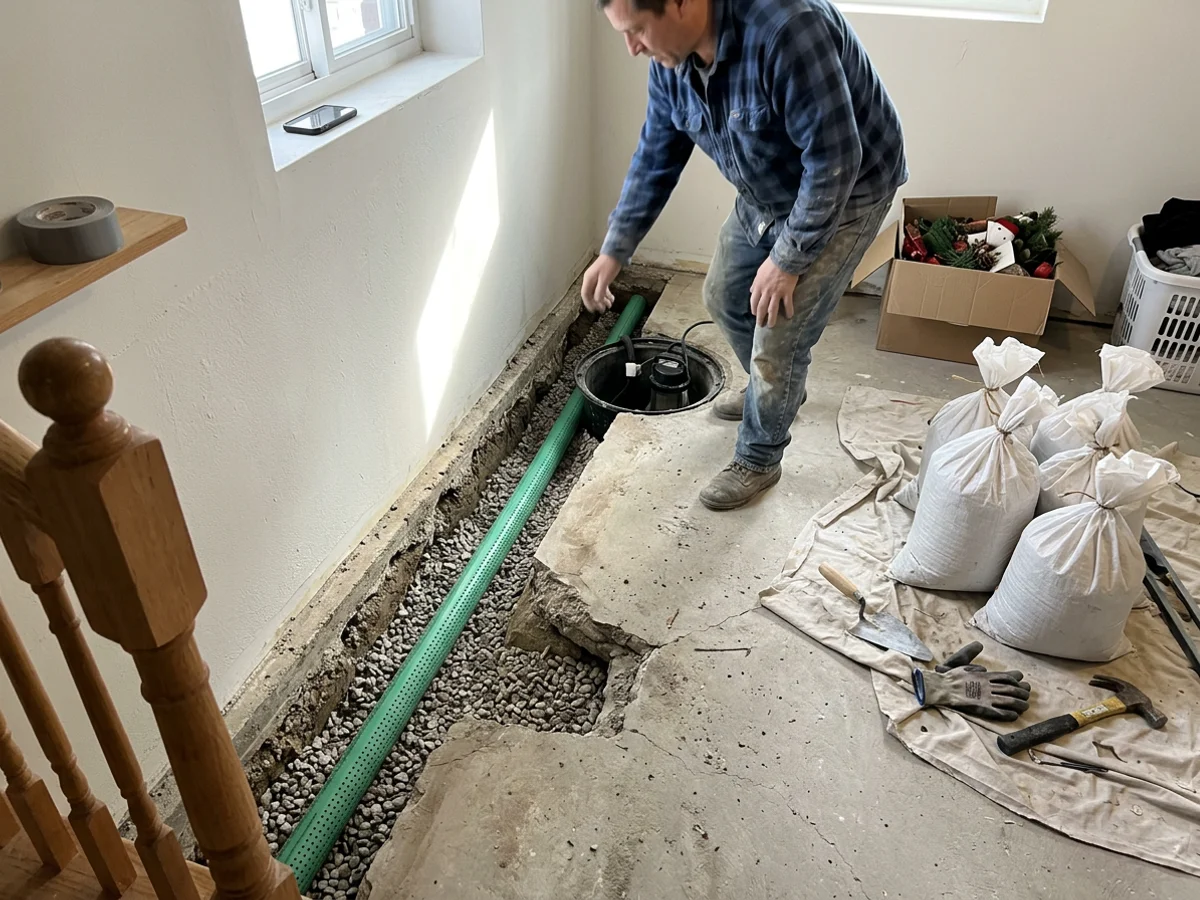
An interior footing drain is installed inside the basement, typically by cutting and removing a strip of the concrete slab around the perimeter. A perforated pipe is placed in gravel, then covered, and it routes to a sump pit where a sump pump pushes the collected water outside.
Design note: systems vary. Some only collect water at the cove joint. Others add a wall flange or drainage membrane to help guide wall seepage down into the trench.
What it does well: collects water at the wall and slab edge so it does not spread across the floor.
What it does not do: it usually does not keep the foundation wall completely dry. It is a water control system, not a full outside barrier.
Exterior French drain (exterior trench drain)
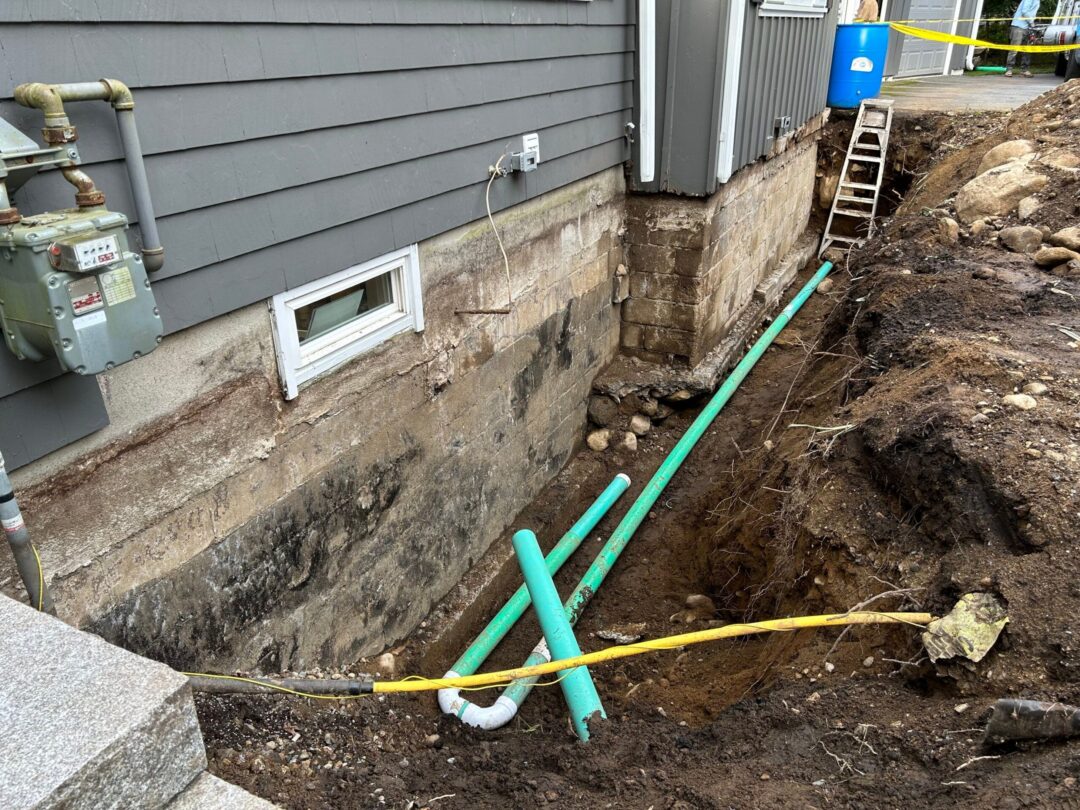
An exterior French drain is installed outside the foundation, typically down at or near the footing. Contractors excavate to expose the foundation wall, place perforated pipe in washed gravel wrapped with filter fabric, and route the water to a safe discharge point.
What it does well: reduces the amount of water sitting against the foundation wall, which can lower pressure and seepage risk.
What it does not do: it is not a magic cure for roof runoff problems, bad grading, or a high water table if discharge is poorly planned.
Match the drain to the symptom
Drain choice gets easier when you match the system to the symptom. Here are the most common patterns.
1) Water shows up after heavy rain, near one wall
- Often means: roof runoff and surface water is saturating soil near the foundation.
- Start with: gutters, downspout extensions, and grading corrections.
- Drain choice: exterior drainage can be excellent here, but interior drainage may still be chosen if exterior excavation is too disruptive.
2) Dampness at the wall and floor joint (cove joint)
- Often means: hydrostatic pressure pushing water to the easiest entry point, the seam where slab meets wall.
- Drain choice: interior perimeter drain systems are designed to collect water at this joint and send it to a sump.
3) Water comes up through cracks or the middle of the slab
- Often means: underslab water pressure or a high water table.
- Drain choice: interior systems can help when paired with a sump, but you may also need targeted crack repair and serious discharge planning.
4) Wet basement when it has not rained
- Often means: condensation, plumbing leaks, or groundwater issues not tied to storms.
- Drain choice: do not assume “French drain” first. Confirm humidity and mechanical sources. A dehumidifier and air sealing may matter as much as drainage.
If you have staining on the ceiling below a bathroom or kitchen, that is a different detective path. This guide can help: Water stain on the ceiling: find the source and fix it.
Installation: what the work looks like
Interior footing drain installation
- Plan the route around the inside perimeter, plus where the sump pit will go.
- Cut and remove slab in a strip along the wall (often 12 to 18 inches wide).
- Excavate a gravel trench down to the footing area.
- Install perforated pipe set in washed gravel, often laid to encourage flow toward the sump pit.
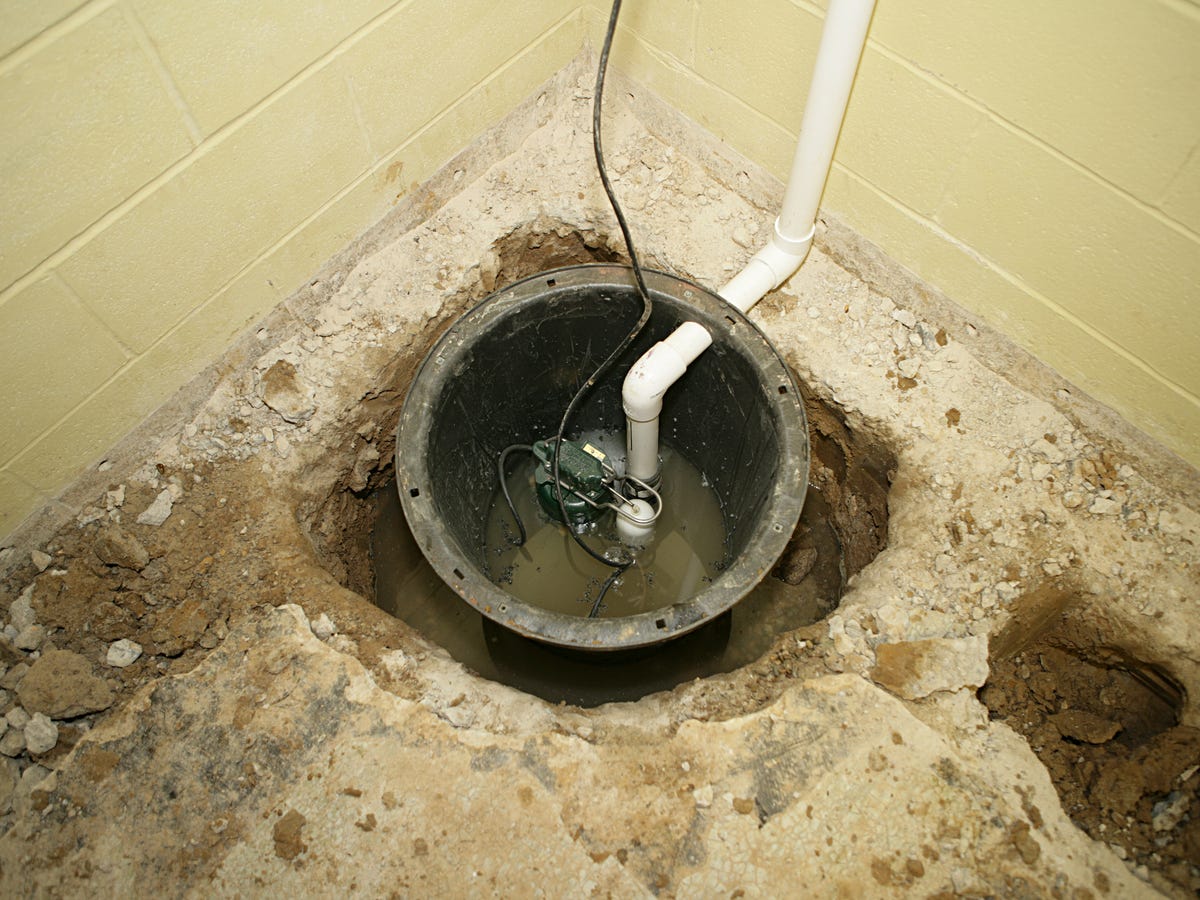
- Install sump basin and pump, including check valve and discharge line to the exterior.
- Backfill with gravel and re pour concrete to restore the floor.
What homeowners notice: noise, dust, a lot of concrete debris, and a basement that is out of commission during the work. Finished basements may require removing flooring and some wall finishes.
Exterior French drain installation
- Excavate down to the footing around problem walls (sometimes the full perimeter).
- Clean and inspect the foundation wall for cracks and weak spots.
- Apply waterproofing (membrane or coating) and often a dimple drainage mat.
- Install perforated pipe at the footing level in washed gravel with filter fabric.
- Discharge the water to a safe outlet, then backfill and restore landscaping.
What homeowners notice: torn up landscaping, possible driveway or walkway removal, and the need to protect utilities and exterior features.
Cost: what drives price
Prices vary widely by region, access, and the amount of perimeter involved, but the cost drivers are surprisingly consistent.
Interior footing drain cost drivers
- Basement size and perimeter length: more linear feet means more cutting, excavation, pipe, and concrete.
- Sump pump needs: single pump vs battery backup, pump quality, discharge routing complexity.
- Finished basement: removing and rebuilding finished walls and flooring can rival the drainage cost.
- Concrete thickness and reinforcement: thicker slabs and rebar slow work.
Exterior French drain cost drivers
- Dig depth: deeper footings require more labor and safety measures.
- Access: tight lot lines, fences, decks, HVAC units, and landscaping obstacles add time.
- Hardscape removal: sidewalks, patios, and driveways can raise costs fast.
- Waterproofing scope: coating only vs full membrane plus drainage board.
- Discharge point: daylight outlet is simplest if the yard slope allows it, otherwise routing can be complex.
Budget note: before paying for any drain system, make sure roof runoff is handled. Overflowing gutters can mimic foundation drainage failure. This can help: Gutters overflowing in heavy rain: causes and fixes.
Which one works best?
| Situation | Interior footing drain | Exterior French drain |
|---|---|---|
| Seepage at wall and floor joint | Usually excellent (captures at entry point) | Good if installed deep enough, best with waterproofing |
| Finished basement you want to protect | Can work, but disruption to finishes is a drawback | Often preferred if you can access the exterior without major demolition |
| Reducing wall moisture and pressure | Limited (does not stop water reaching wall) | Strong (intercepts water outside) |
| High water table risk | Often practical with a reliable sump and backup | Can help, but discharge and depth must be right to matter |
| Limited outdoor access | Usually easier to execute | May be difficult or very expensive |
| Radon concerns during work | May require careful sealing around sump and slab patches | Less interior disturbance, but still coordinate with mitigation if present |
Common myths
“Interior drains are a scam because they let water in.”
Interior systems are usually designed as water management. If water is already forcing its way to the cove joint, capturing it and pumping it out can keep the basement usable and protect finishes. That is not the same as exterior waterproofing, but it can still be the right tool for the job.
“Exterior drains always fix everything.”
Exterior drains work best as part of a full exterior plan: waterproofing on the wall, free draining backfill, and a reliable discharge path. A pipe in mud with nowhere to send water is not a victory.
“If I add a drain, I do not need gutters and grading.”
Gutters and grading are usually the first line of defense. If your downspouts dump water next to the foundation, no drain system should be asked to do that job alone.
Decision guide
Choose an interior footing drain if
- You get seepage at the wall and floor joint and want the most direct way to collect and remove it.
- Exterior excavation is blocked by patios, decks, property lines, or major landscaping.
- You can commit to sump pump reliability, including maintenance and possibly a backup system.
- You want a solution that is often less expensive upfront than full exterior excavation and waterproofing.
Choose an exterior French drain if
- You want to reduce water pressure on the foundation and keep the wall itself drier.
- You have recurring seepage and you can excavate without destroying half the yard.
- You are already planning exterior work (landscaping redo, replacing walkways, foundation repair) and can combine projects.
- You are pairing it with exterior crack repair and waterproofing for a true outside barrier approach.
Consider a hybrid if
- You have a high water table and visible seepage paths.
- You want exterior waterproofing but also want interior redundancy for extreme storms.
- Your basement will be finished and you want layered protection.
Details that matter
Discharge location and local rules
Every drain system is only as good as where the water goes. Discharging too close to the foundation, toward a neighbor, or into a spot that erodes can send water right back where it started.
Rules vary: many municipalities prohibit connecting sump or footing drains to sanitary sewer, and storm connections may require permits, backflow protection, or specific materials. Plan the discharge first, not last.
Cold climate discharge issues
In freezing weather, a poorly routed discharge can create icy sidewalks, frozen lines, or water that backs up and short cycles the pump. Routing, burial depth, and where the outlet daylights all matter in winter zones.
Filter fabric, gravel, and clog resistance
Exterior drains live in soil. Without proper filter fabric and clean washed gravel, fines can clog the system over time. Interior drains can clog too, but they are usually in a controlled gravel trench with less soil exposure.
Sump pump details to ask about
- Sealed sump lid: helps with humidity control and keeps basement air cleaner.
- Radon rated lid: especially important if you have radon concerns or mitigation.
- Backup plan: battery backup, water powered backup where allowed, or a generator plan.
- Alarm and check valve: useful for catching failures early and preventing backflow.
- Where the discharge ends: confirm it is far enough from the foundation and not aimed at problem areas.
Window wells are a common wildcard
If leaks show up under a basement window after storms, a French drain may not be the whole story. Clogged window well drains, missing gravel, poor well height, or water dumping into the well from a downspout can all cause “foundation leaks” that are really a window well problem.
Don’t ignore cracks
Drains manage water, but foundation cracks can become direct pipelines. Crack repair and drainage are often teammates, not rivals.
When to bring in a pro
Basement water can be simple, but it can also be structural, electrical, or health related if mold becomes a problem. Consider professional evaluation when:
- Water entry is sudden and severe.
- Walls are bowing, cracking significantly, or the floor is heaving.
- You need to tie into storm systems or you are unsure about local discharge rules.
- You have a finished basement and want to avoid expensive rework.
If you are shopping for a home and want to avoid surprises, it helps to understand what inspectors commonly flag. Here is a helpful overview: Top 10 home inspection issues and why moisture problems show up so often: Why home inspections matter.
FAQ
Is an interior French drain the same as a footing drain?
People use the terms interchangeably. In most basement waterproofing conversations, an “interior French drain” usually means an interior perimeter drain installed alongside the footing that routes to a sump.
Will an interior drain increase humidity?
It can if the system leaves exposed water or air pathways inside the basement, like an open sump pit, an unsealed lid, or gaps around penetrations. A sealed lid and steady dehumidification, when needed, usually make a noticeable difference.
Do I always need exterior waterproofing with an exterior drain?
If you are excavating to the footing anyway, adding a true exterior waterproofing layer is often the best timing. A drain alone can help, but waterproofing and a drainage mat typically improve the result.
What is the first step before spending money on drains?
Handle surface water first: gutters working, downspouts extended away from the house, window wells draining, and soil sloping away. Those basics can reduce or even eliminate the need for more invasive work.
The 30-second cheat sheet
The key points from this guide, in one place.
- Interior footing drains manage water after it reaches the basement by collecting seepage at the wall and floor joint and sending it to a sump pump.
- Exterior French drains intercept groundwater outside near the footing, reducing pressure on the foundation wall and helping keep the wall itself drier.
- If seepage shows up at the cove joint: interior perimeter drains are often the most direct fix.
- If you want to lower seepage risk: exterior drainage paired with exterior waterproofing is usually the most direct approach, but results depend on discharge, soil conditions, and entry points above the drain.
- Big cost drivers (interior): finished basement demo, perimeter length, sump pump and discharge routing.
- Big cost drivers (exterior): excavation depth, access, removing patios/walkways, and where the drain can discharge.
- Do this first either way: fix gutters, extend downspouts, and correct grading so roof runoff is not soaking the foundation zone.
- Best results often come from layers: surface water control + the right drain type for the symptom + crack and window well repairs where needed.